In the evolving landscape of nondestructive testing (NDT), the integration of advanced technologies is pivotal in addressing the challenges faced by inspection companies. One such challenge for experienced inspectors such advanced Level IIIs is providing timely mentorship to new inspectors, especially when they are not physically present on site. Charles Hansen, owner of HansenNDE, shares his insights on how Evident’s Remote Collaboration Service (RCS), a videoconferencing app for the OmniScan™ X4 phased array flaw detector, is transforming peer learning and oversight in the NDT industry.
Passing It On: How Friendship and Mentorship Shaped HansenNDE
Charles Hansen’s journey in NDT began in 2007, rooted in hands-on experience across multiple methods including radiographic (RT), ultrasonic (UT), magnetic particle (MT), penetrant (PT), and visual testing (VT). Early in his career, Hansen recognized a deep interest in UT, investing in his own equipment and devoting many hours to mastering shear wave techniques.
Hansen says he owes a lot of his education to the generosity of more experienced inspectors willing to share their knowledge. “I had a great friend who taught me after my normal shift at the plant where I worked. I would go with him to do these jobs where I would scan the welds first using UTSW (ultrasonic shear wave) and give him my feedback on what I saw, then he would scan it with PAUT (phased array UT) and would let me know how I did and what I saw, didn’t see, and explain any signals that I had in question. After about a year of doing this process and practicing at home, I had enough UTSW hours and was ready for formal classroom training.
A pivotal moment came when he enrolled in an ultrasonic course taught by Mark Davis at the University of Ultrasonics in Birmingham, Alabama—a decision that not only expanded his technical knowledge but also connected him with a mentor who would later play a significant role in his development.
“After working all over the country for several years straight, I went back home to Louisiana to manage a UT department for an inspection company. Shortly after being hired, I had a technician identify a crack that was not there after I verified on site. After talking to the plant owner, he wanted to know if I could help build a program for vetting technicians before they can be approved for scanning in their plants. I referred him to Mark Davis to help build a Performance Demonstration Qualification (PDQ) program for them, as that program development aspect was foreign to me at the time. A few months went by, and Mark called me to check in and after a short conversation offered me a job at his company, VeriPhase.”
Later, working alongside Davis at VeriPhase, Hansen gained invaluable exposure to advanced NDT practices including data auditing, PDQ programs, NDT classes, procedure development, and third-party review. These formative experiences shaped his belief in the power of mentorship, a principle that now defines his own company.
“Mark has been a great friend and mentor of mine and was the one who really jump started the idea of HansenNDE.” Today, Hansen provides both training and Level III consulting with the goal of equipping the next generation of inspectors with the same kind of expert guidance that helped him advance.
Empowering New Inspectors with Real-Time Expert Guidance Using the OmniScan™ X4 RCS
The Remote Collaboration Service (RCS) is a videoconferencing-based application that seamlessly connects the OmniScan X4 phased array flaw detector with smartphones and other collaborators via their devices, enabling features such as screen sharing and enabling remote control of the acquisition unit.
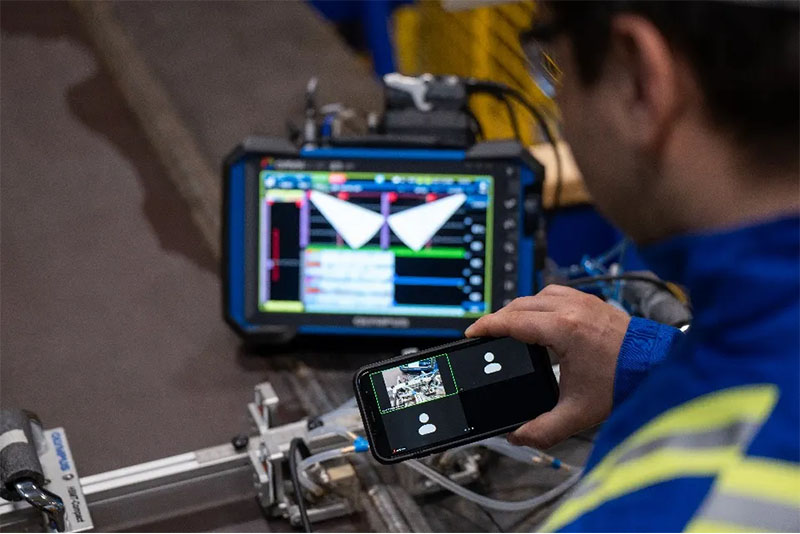
The RCS connects collaborators via the OmniScan X4 unit enabling them to share their mobile device’s live video in a meeting (to stream images of the inspection configuration) or the X4’s screen in real time.
“I utilize RCS to remotely supervise inspections, allowing for real-time collaboration and oversight without the need for my physical presence on-site. This has been a gamechanger for quick decisions,” Hansen says. Hansen later stated that this could have altered the decision of the technician that identified the crack if RCS had been available at that time. “The technician could have patched me in at that very moment,” he said.
He lists what he sees as RCS’s key benefits
- Enhanced Efficiency: Reduces the need for travel, saving time and resources.
- Immediate Expert Input: Facilitates real-time guidance and decision-making.
- Improved Communication: Eliminates reliance on poor-quality photos or videos of the acquisition unit’s display.
- Accessible Mentorship: Provides new inspectors with instant access to experienced professionals, fostering learning and confidence.
Hansen expands, “I can provide guidance to inspectors in the field, regardless of location. They may have last-minute questions on what call to make, and they can share their screen so I see their A-scan, S-scan, B-scan, or C-scan imaging in clear detail, as clear as if I were there with them.”
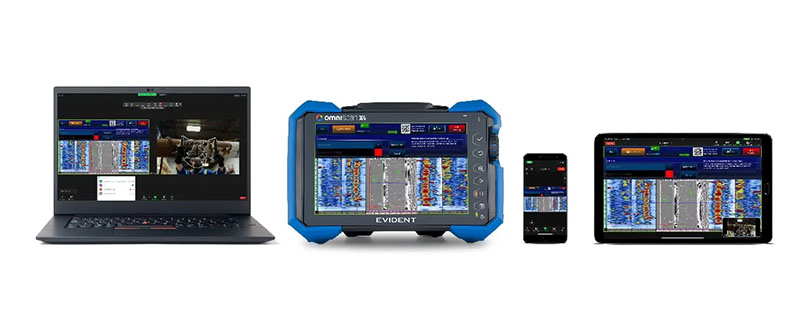
Screen sharing the OmniScan X4 display to the devices of collaborators using the RCS app
Overcoming Challenges Inherent to Inspecting in Remote Locations
While the RCS has provided many advantages for his business, Hansen admits that the remote locations of some inspection jobs initially raised connectivity concerns. However, it hasn’t been an obstacle as he’s managed to find a workaround, “Connection speed for remote areas may be slower, but a simple cell phone hotspot works very well, even with just one bar of service and areas with little to no service, Starlink has expanded these remote areas.”
Evaluating Alternatives: Why RCS Stands Out
Prior to adopting the RCS, Hansen experimented with other platforms for remote supervision. “We tried Facetime and Google Meet to watch the inspection instrument’s screen, but you are never able to see the sharpness of the screen and A-scan like you can using the built-in RCS software.” Through extensive trial runs, Hansen determined that the RCS offers a more reliable and effective means of remote collaboration.
Tangible Improvements with OmniScan X4 and Remote Collaboration Service
Transitioning from the OmniScan X3 phased array flaw detector to the OmniScan X4, Hansen has observed notable enhancements in speed and responsiveness. Integrating its RCS app into his process has led to significant cost savings by minimizing travel and expediting inspection turnaround times. Unlike other conventional data acquisition devices, the OmniScan X4 RCS’ screen-sharing functionality provides clear data visibility in the field.
Hansen says it proves its worth with every use, “Every time I use the RCS to resolve a last-minute ‘what do you think this is’ question from an inspection technician, it’s so valuable, as time is critical during inspections. That crucial feedback cannot be given 12 hours later while trying to get to the airport. It paid for itself after the first time I used it!”
Hansen also commends the exceptional support provided by Evident’s sales representatives and technical teams, “My local sales rep can answer just about any question I throw at him. But for the very technical questions, the NDT Application Engineering (AE) team at Evident’s Houston office do a phenomenal job. Can’t thank them enough for what they do behind the scenes to resolve my questions. That level of support is rare in today’s world.”
Looking Ahead: The Future of Remote Collaboration in NDT
Hansen envisions a future where remote collaboration becomes integral to NDT practices. He makes a prediction, “I see RCS usage growing rapidly in the next 10 years. I don’t know what that looks like then, but with the quick progression of technology, I can’t wait to see what it looks like!”
Conclusion: Building a Culture of Shared Expertise
For Charles Hansen, the value of mentorship is more than a personal story—it’s a professional imperative. His own advancement was accelerated by accessible, expert guidance at critical moments, and he is now committed to offering that same support to new inspectors.
Through HansenNDE, and with the help of tools such as the Remote Collaboration Service (RCS) paired with the OmniScan X4 phased array flaw detector, Hansen is able to extend his mentorship beyond the classroom or jobsite. Whether providing immediate feedback during live inspections or supporting Level III responsibilities across the country, he is fostering a culture where experience is shared, and learning is continuous.
As the NDT industry embraces remote and digital solutions, Hansen’s approach represents a forward-thinking model for how mentorship can evolve, and its reach can expand exponentially.
Interested in enhancing your NDT operations with remote collaboration? Explore how the OmniScan X4 phased array flaw detector and the X4 RCS can transform your inspection processes.
If you are interested in more details, reach out to your local Evident representative or contact us.
Related Content
5 Ways to Gain an NDT 4.0 Edge with the X3 Remote Collaboration Service
Combine Advanced Analysis and Powerful Acquisition into a Portable Inspection Ecosystem