


1. Background
High-performance superalloys such as GTD-111, Rene 108, CM247LC, Waspaloy, and Inconel 939 are widely used for manufacturing hot-section components, including blades, vanes, buckets, and discs. These alloys support demanding applications in the aerospace, energy, and chemical industries—particularly in land-based industrial gas turbines and aerospace jet engines—due to their high-temperature strength, corrosion resistance, and creep resistance.
Given the high cost of raw materials, recycling and reprocessing are essential within the superalloy manufacturing ecosystem. Specialized companies process superalloy scrap and revert materials using proprietary methods to generate high-quality meltstock for primary manufacturers.
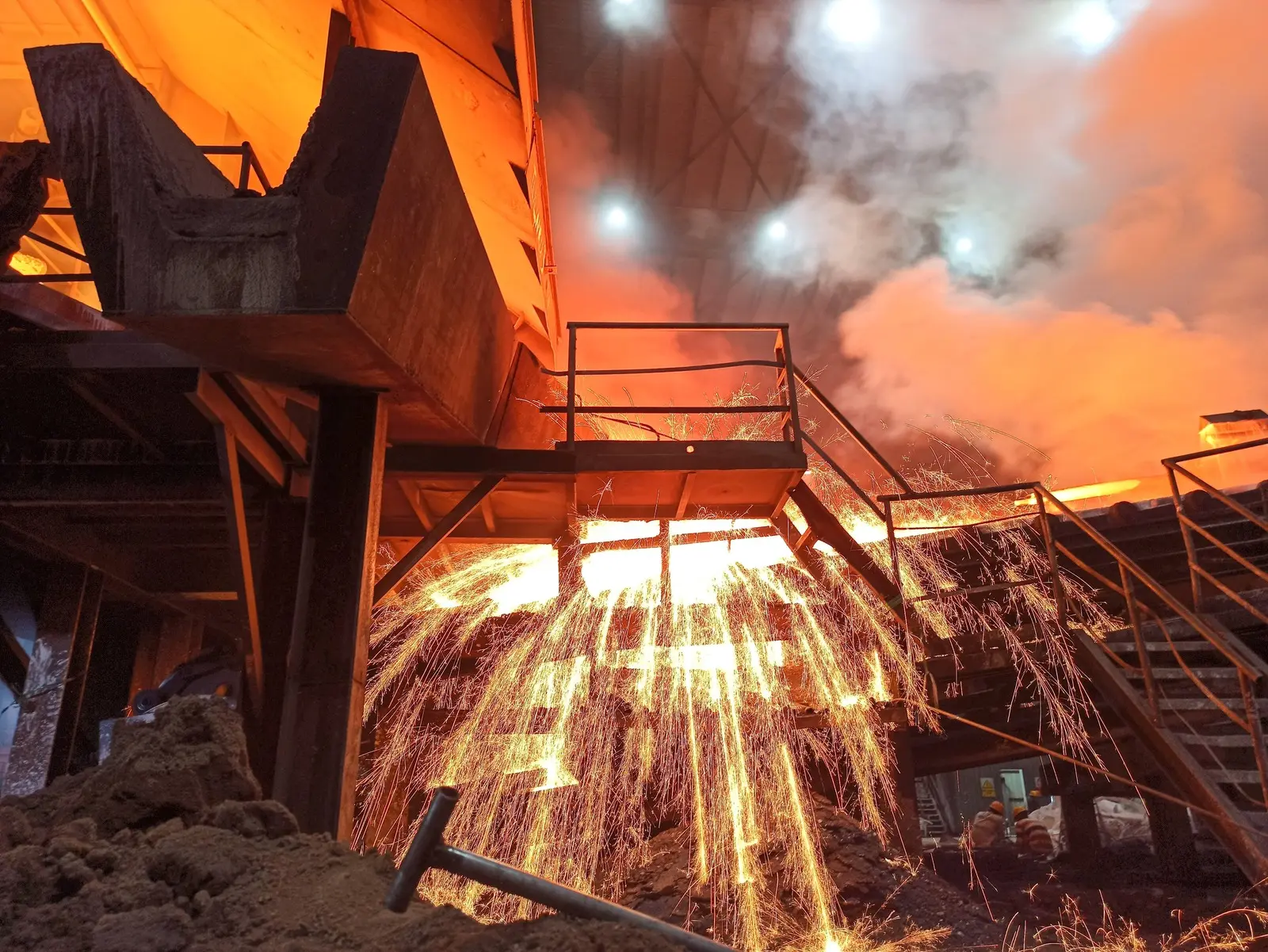
GTD-111 — Certified Zr value: 30 ppm; Measured: 31 ppm ± 12 ppm
2. Technical Challenge
Monitoring the zirconium (Zr) concentration is critical in nickel-based superalloys such as GTD-111 and Rene 108. Zirconium is typically added in trace concentrations, often in the parts-per-million (ppm) range, and has a significant effect on the alloy’s microstructure and mechanical behavior. Precise control of Zr is required because both insufficient and excessive amounts can compromise alloy performance.
Zirconium contributes to grain-boundary strengthening, creep resistance, purification, and carbide formation. However, elevated Zr levels present several risks:
- Hot cracking: High Zr concentrations, especially when combined with boron, can increase susceptibility to hot cracking during casting or welding by promoting low-melting liquid films at grain boundaries during final solidification.
- Embrittlement: Excessive Zr can lead to the formation of brittle Ni-Zr intermetallic phases at grain boundaries, reducing ductility and toughness.
- Loss of ductility: Studies show that high Zr additions negatively influence tensile properties, largely due to the increased concentration of grain-boundary phases.
- Detrimental phase formation: Elevated Zr can disrupt the precipitation behavior of strengthening phases such as the gamma-prime phase.
To mitigate these risks, recyclers and reprocessors must tightly control Zr concentration in meltstock before supplying material to primary manufacturers, particularly for applications involving conventional casting or additive manufacturing.
Portable X-ray fluorescence (pXRF) systems offer an effective means of separating and sorting materials for reprocessing and for quickly assessing Zr concentrations. These measurements help increase the value of recycled material and reduce the risk of introducing high-Zr material into the melt.
3. Solution Overview
Accurate differentiation between low- and high-Zr nickel-based superalloys is a key requirement in meltstock preparation and quality control. Mixing materials of differing Zr concentrations poses substantial performance risks for downstream applications.
The Evident VANTA™ Core handheld XRF analyzers (V2CR, V2CA) and the Evident VANTA™ Element-S handheld XRF analyzer (V2EL-SDD) provide a rapid, sensitive method for assessing Zr content. These analyzers offer non-destructive measurements capable of detecting Zr concentrations as low as 20 ppm within seconds.
This capability enables immediate, on-site verification of trace-level Zr content as well as full alloy composition. Typical analysis times of only tens of seconds reduce or eliminate the need to send samples off-site for laboratory confirmation.
In addition, the VANTA analyzers’ PseudoElements feature, available on all models, automatically calculates and displays the Zr concentration in ppm directly on the screen. This enables fast, data-driven decisions for separating materials with high or low Zr content, improving sorting efficiency and reducing the financial and operational risks of incorrect meltstock classification.
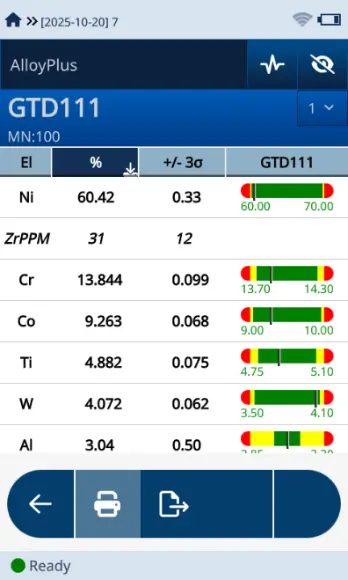
GTD-111 — Certified Zr value: 30 ppm; Measured: 31 ppm ± 12 ppm
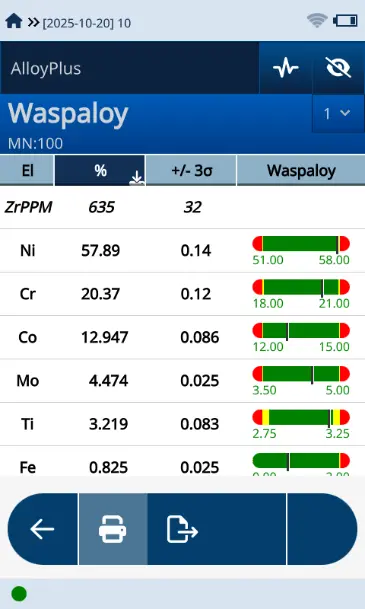
Waspaloy – Certified Zr value = 600ppm / Measured = 635ppm +/-32ppmm
4. Considerations and Limitations
Although XRF analysis is non-destructive, achieving optimal accuracy—particularly for trace-level Zr measurements—requires proper sample preparation. The analysis area must be clean, flat, and free from surface contamination, scale, oxidation, or plating.
For scrap-yard or as-cast materials, light grinding or abrasion is often necessary to expose the true substrate. Operators must also ensure that the instrument’s measurement window sits flush against the surface, as uneven or curved geometries can compromise analytical precision.
5. Conclusion
Nickel-based superalloys play a central role in aerospace and energy applications, and this importance extends to the recycling supply chain that supports their production. Monitoring Zr concentration is therefore a critical quality-control step, as deviations in Zr content can directly affect high-temperature strength and structural integrity in components such as turbine blades.
The Evident VANTA handheld XRF analyzers provide a practical solution for on-site Zr verification, offering high sensitivity in the ppm range and rapid, non-destructive measurements. With the Pseudo Elements feature delivering immediate quantitative results, operators can confidently segregate meltstock, protect material value, and support the reliable production of high-performance superalloy components.