Evident LogoEvident Logo
洞见博客

Using XRF to Tackle Lunar Dust: NASA’s Quest for Clean Space Exploration

作者  -

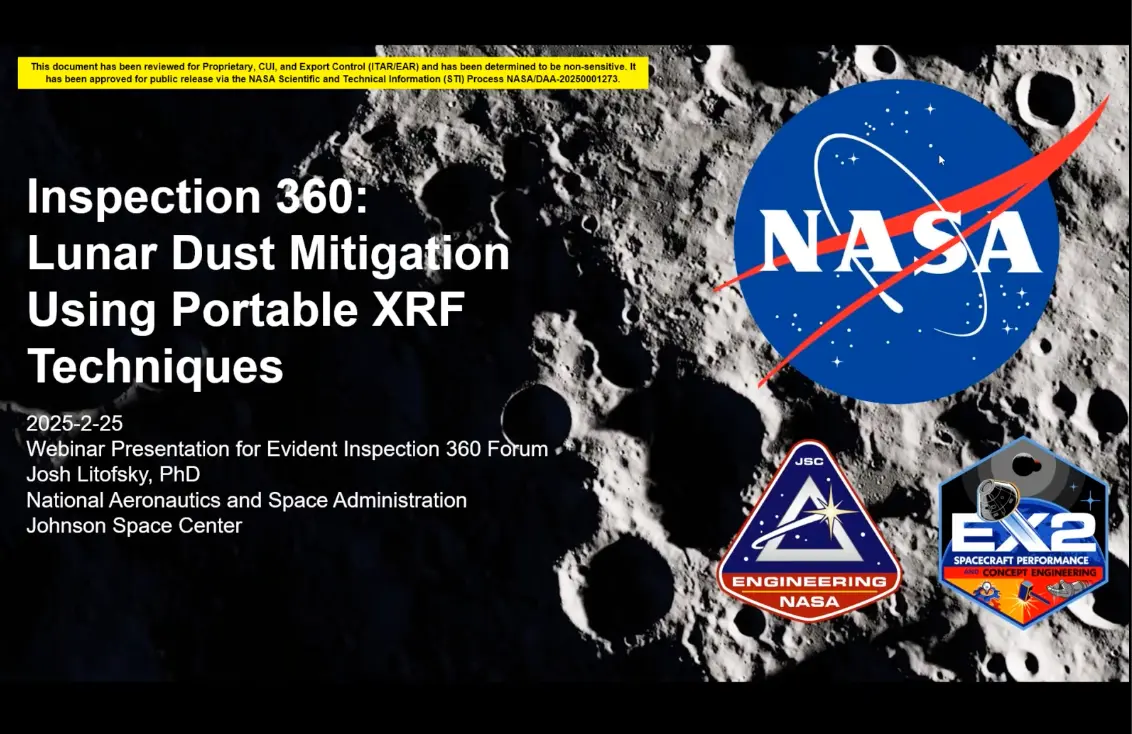
As humanity prepares to return to the Moon with the Artemis missions, one gritty challenge has reemerged as a serious threat to mission success: lunar dust. In a recent Inspection 360 webinar hosted by Evident Scientific, Dr. Josh Litofsky, an aerospace technologist at NASA’s Johnson Space Center, shared insights into how portable X-ray fluorescence (XRF) technology is being adapted to measure and mitigate this persistent problem.

Why Lunar Dust Matters

Lunar dust isn’t just dirt—it’s a unique, ultra-fine, and jagged material that clings to everything. From the Apollo missions, astronauts reported eye and skin irritation, clogged joints and seals, and dust-covered suits and equipment. Lunar dust is electrostatically charged, abrasive, and pervasive—making it both a nuisance and a hazard for crew health, vehicle functionality, and mission reliability.

But how do you quantify something you can’t easily see or remove?

The Measurement Problem

Testing with actual lunar dust is limited—NASA only has a few hundred kilograms brought back from Apollo. So researchers rely on lunar “simulants,” Earth-based materials made to mimic lunar regolith, to test new dust mitigation strategies.

One of the biggest challenges has been measuring how much dust remains after cleaning efforts—especially on large or irregular surfaces like spacesuits and spacecraft.

XRF to the Rescue

Dr. Litofsky's work explores a solution: using portable XRF analyzers to quantify dust directly on surfaces without removing it. Traditionally used for scrap metal sorting and mining applications, XRF devices are rugged, easy to operate with gloves, and deliver near-instant elemental analysis.

By focusing on tracer elements—like titanium or calcium—that are abundant in lunar dust but not in suit or spacecraft materials, the team developed a technique to estimate dust loading (mass per unit area) using XRF.

They validated this method by:

  • Creating calibration samples with known dust levels.
  • Scanning spacesuit gloves, boots, solar panels, and vehicle components.
  • Generating heatmaps to show dust concentration across surfaces before and after cleaning.

The results showed excellent correlation between XRF readings and actual dust amounts, outperforming traditional weight-based methods—especially on large, irregular items.

A Future on the Moon—and Mars

While developed with Artemis in mind, this XRF method can be adapted for Mars and other planetary surfaces, where dust composition differs but the problem persists. It enables quick, point-and-shoot assessments of whether cleaning techniques are working—without needing to remove dust or transport samples.

What’s Next?

Dr. Latofsky emphasized two goals going forward:

  1. Formalizing the method to ensure it's reliable, repeatable, and usable by any operator—even on the lunar surface.
  2. Adapting XRF hardware to withstand the extreme conditions of space: vacuum, cold, radiation, and low-gravity.

NASA is also working on converting this technique into a decision-making tool—creating go/no-go thresholds for dust levels and supporting hardware development that will ensure mission-critical systems remain clean and functional.

Final Thought

As Dr. Litofsky put it: “This technique doesn’t remove the dust—it just tells you whether your cleaning worked.” And when it comes to safeguarding astronauts and multimillion-dollar equipment on another world, that’s information you can’t afford to leave behind.

*Trade names are used in this presentation for identification only. Their usage does not constitute an official endorsement, either expressed or implied, by the National Aeronautics and Space Administration.

高级产品经理(分析仪器)

Michael Hull是Evident分析仪器部门的高级产品经理。在日常工作中,他协助XRF的用户寻找量身定制的解决方案。Michael拥有圣母大学无机化学博士学位。他利用X射线技术进行结构表征、成分测定和分析鉴定。在加入Evident之前,他曾在西北密苏里州立大学任教,也曾在莱斯大学和科罗拉多矿业学院担任客座研究员。

二月 10, 2026
Sorry, this page is not available in your country
InSight Blog Sign-up
Sorry, this page is not available in your country
Let us know what you're looking for by filling out the form below.
Sorry, this page is not available in your country